AI writes it.CodexQA proves it.
Code graphIntelligent testingCode coverageAI test generationAI defect detectionE2E automation
Every step comes with evidence an agent can fix from, so every merge has grounds.
Use codexqa-defect-analyzer to review this branch. Requirement: a refund must not exceed the remaining refundable balance.
- 11 open-source skills
- Public blind test: 7/7 recall, 0 false positives
- Runs locally, no account
- Private deployment
- Your choice of model
01Why verify
AI proves it finished writing. CodexQA proves the code is right.
The faster AI writes, the further verification falls behind.
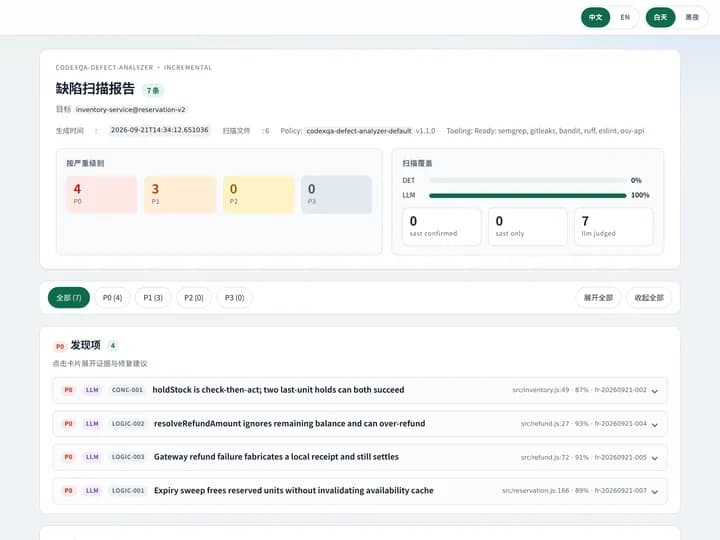
- src/refund.jsDefect foundAgent: refunds are done All tests passCodexQADo not merge
D5 · Gateway refund fails, ledger still updated
src/refund.js:56–91 · refundOrder
AI tests itself: all-green proves nothing
The AI only tests the happy path it imagined—swallowed exceptions, concurrency bugs, and real edge cases are missed. CodexQA verifies independently outside the agent: rules stop regressions, AI traces call chains for counterexamples, and real browsers check visible proof.
- checkout · change impactGraph tracedPOST /orders→checkout→applyDiscountcheckout_applies_discount Recalledverify_jwtNo test → add one
Changed two lines, what breaks downstream?
When AI modifies dozens of files at once, reviewers can’t keep up. Guessing the blast radius causes production regressions or 2-hour full test runs. A code graph traces real call chains, recalls only the affected tests, and flags untested blind spots.
- guard · audit & securityAir-gapped
- Requirement gap · marked TBDHuman sign-off
- Test data · real backend IDsReal backend
- Runs locally · no accountOffline
- Private deploymentIntranet
Hallucinated specs, fake data & data leakage fears
When specs are vague, AI invents assumptions; generated mock data fails against real databases. CodexQA flags missing specs as TBD for human sign-off, uses genuine backend IDs, and runs entirely on your local machine with private model support.
02The method
Independent verification, six steps to merge
Graph the blast radius, check defects two ways, keep browser proof. 11 open-source skills.
Build an architecture knowledge graph locally: how modules layer, where the real dependencies and hubs are. Requirement gaps and testability are logged first too.
- code-wiki
- requirement-analyzer
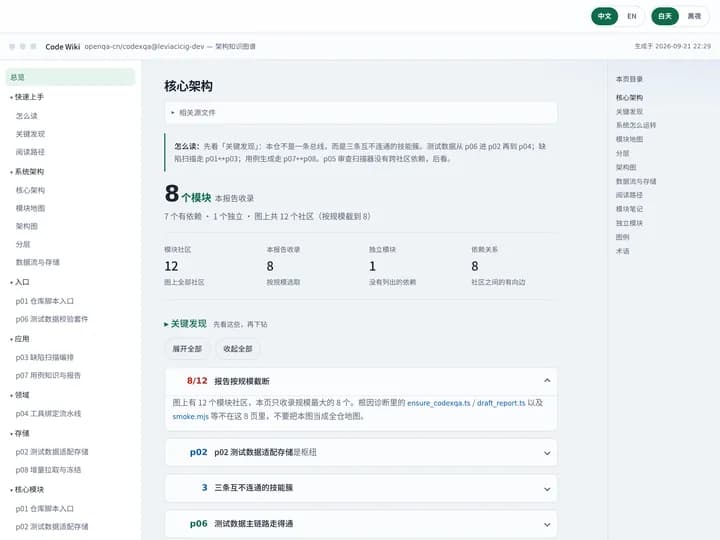
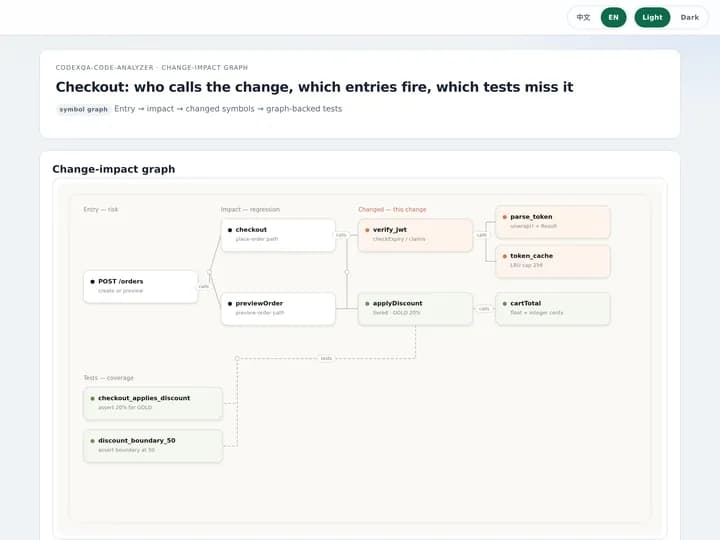
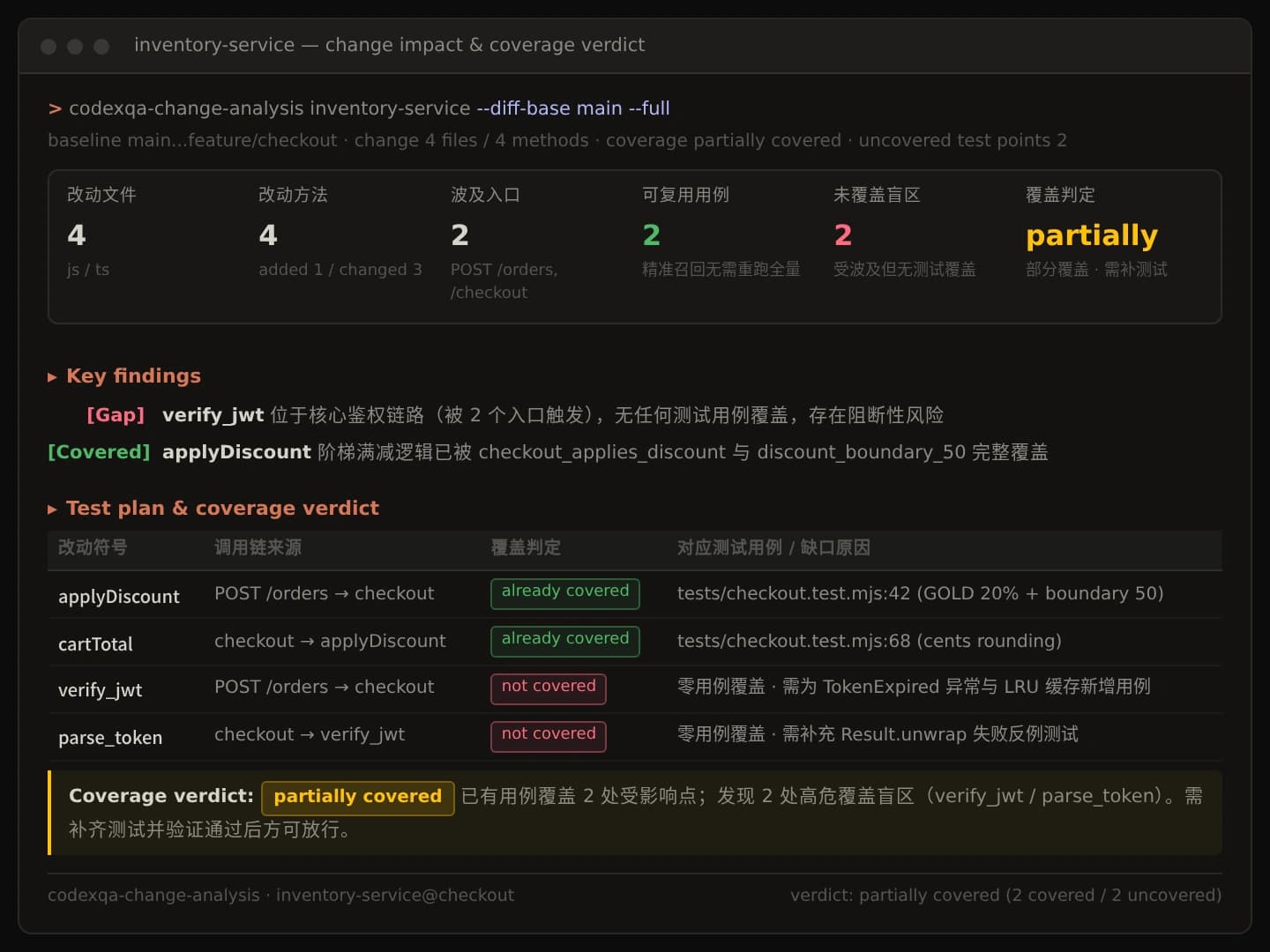
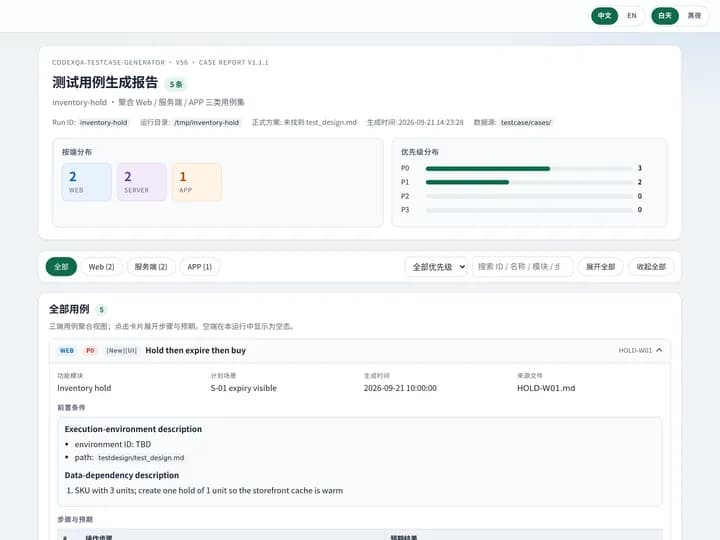
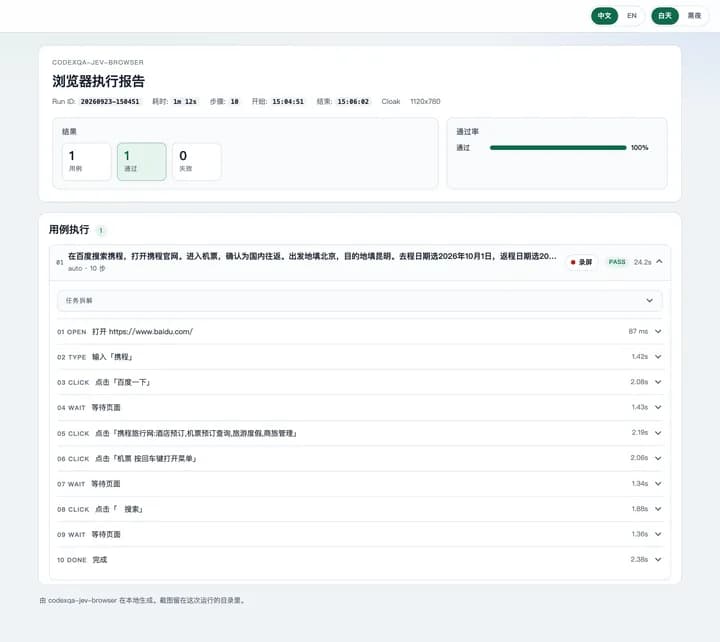
Plus rootcause-analyzer for exception root causes and skill-router to pick the right skill from your words. Everything runs locally, with no account and no extra model key.
03Public evidence
Trust from evidence, not self-grading
Recall 7/7, 0 false positives; cases 7/7, rules 9/14, code 93.2%, APIs 33/39, chains 2/2. Every number reruns, gaps listed.
- 01
Independent, checked against a public key
ground-truth.jsonThe verifier is not the agent that wrote the code, and every result is checked against the answer key: all 7 defects found, none of the 4 decoys flagged.
- 02
Evidence on every conclusion
JSONLocation, expected, actual and trigger come out as JSON the agent reads and fixes from; anything not reported carries a reason.
- 03
What was checked, and what was not
Test cases, requirements, code, interfaces and call chains each get a number, gaps listed.
- 7/7Test cases
- 9/14Requirements
- 93.2%Code
- 33/39Interfaces
- 2/2Call chains
feature/reservation-v2→main- Changed functions
- 12
- Defects found
- 7
- Suspicious code checked
- 4correct, not reported
- Against answer key
- 7/7
refund.js:18 · §11Spec deviation§11refund.js:18Lowrefund.js:56 · §12Swallowed error§12refund.js:56Lowinventory.js:49 · §4Async race§4inventory.js:49Midpricing.js:32 · §8Off by one§8pricing.js:32Lowdb.js:186 · §14Resource leak§14db.js:186Midreservation.js:93 · §5Cross-file invariant§5reservation.js:93Highreservation.js:162 · §6Cross-method state§6reservation.js:162Mid$ node examples/inventory-service/verify.mjsPASS: 7 seeded defects reproduce, 4 decoys behave correctly.One recorded run (Composer, 2026-09-08): one model, one run, not a multi-model benchmark.
Not a report for people, feedback an agent can fix from
Every finding carries location, expected, actual and trigger. The agent fixes it, CodexQA verifies again, until it passes.
“Refunds are done and all tests pass.”
All tests passPaths its tests walked
- Gateway succeeds → ledger updated, success returnedTested
- Gateway fails → ledger untouched, failure returnedUntested
Its tests never exercised a failing payment gateway.
{
// Where
"location": "src/refund.js:56–91 · refundOrder",
// Expected
"expected": "On gateway failure, leave the ledger untouched and return a failure (rule 12)",
// Actual
"actual": "Fakes a local receipt, updates the ledger and returns ok: true",
// Trigger
"trigger": "gateway.failNextRefunds(1), then refundOrder"
}
- Back to the agent
- Fix to expected
- Verify again
- Pass
Taken from the answer key of the public inventory-service example (defect D5).
04Delivery
Agentic SDLC: keep your process, make AI delivery real
Keep your repos, CI and release process; hand each step to an agent. Two quality gates hold the line, and failures return to coding with root cause and evidence.
Timo · Internal · opens 2026 Q4
- 1Requirements specRequirements analysisThe request is written up as a spec with features and acceptance criteria.
 Requirements analyst
 - 2Technical design specDesign agentReads the existing code and produces the technical design spec.
 Architecture analyst
 - 3ImplementationCoding agentImplements the change against both specs, writes unit tests, and runs the build and static scan before handing off.
 Software engineer
 - 4Component testing and quality gateComponent test agentRuns unit tests with coverage, API tests and code review. If the gate fails, the defect analyst runs root cause analysis and it goes back to coding.
 Test engineer
 Code reviewer
 Defect analyst
 - 5Test preparation (shift-left)ParallelTest design agent, test data agentTest cases and test data are prepared from the requirements and design.Test engineer
- 6Integration testing and quality gateIntegration test agent: API integration, end-to-endRuns integration tests with the prepared test cases and test data. If the gate fails, it goes back to coding with test evidence.Test engineerDefect analyst
- 7ReleaseRelease processOnce both quality gates pass, ships through the release process.
01Spec-driven development
Requirements and technical design are written as specs first; code and tests are baselined against them and stay traceable.
02Two quality gates
Component testing and integration testing each have a quality gate, and both must pass before release.
03Closed-loop defects
Defects that fail a gate return to the coding agent with root cause analysis and test evidence, and are regression-tested after the fix.
04Shift-left testing
Test design and test data preparation run from the specs while the code is written, off the critical path.
Illustrative flow. Timo is in internal use.
05Enterprise services
More than a tool: AI engineering, put to work
Start with one pilot: AI in requirements, code, testing and release, all on-premises.
AI software quality assurance
Delivered per project
AI testing, code review and defect analysis in your delivery flow, so every delivery comes with results, evidence and a clear verdict.
Enterprise servicesAI engineering consulting
Pilot first, then expand
Start with one pilot, design how AI takes part in engineering, train the team, and expand once it has proven itself.
Enterprise servicesAI agent evaluation
Before and after launch
Evaluation sets and scoring for your own agents, RAG and LLM features, so launches rest on evidence and model changes re-check fast.
Enterprise servicesAI agent development
From use case to launch
Choose the use case and design together, build the agent, connect it to internal systems and knowledge, and hand over after evaluation.
Enterprise services
06Security and private deployment
Your code and data stay inside your boundary
Worried about code leaving the building or failing a security review? Deploy to your own requirements, from one skill on a developer laptop to the desktop app, models and solutions fully on-premises.
Runs locally
CodexQA Skills run inside your agent, write reports to the local disk and need no account. How source context is handled depends on the agent and model you use.
Private models
Connect models deployed inside your company. With private deployment and internal models, code and data can stay entirely on your network.
The whole solution on-premises
Timo supports intranet and private deployment, and models and solutions such as quality assurance can be deployed alongside it. Private deployment of the CodexQA platform can be evaluated.
Open to inspection
The skills are open source under Apache-2.0 / MIT, so every instruction and script can be reviewed; the local analysis engine some skills use is distributed separately and closed source.
07Get started
Three ways in, from one skill to the platform
Start free with skills in your agent; add the platform or a private deployment when needed.
$ npx skills add openqa-cn/codexqa
? Which agent? › Cursor
CodexQA Skills
Available
Install into Cursor, Claude Code or Codex. Runs locally and writes HTML reports you can open.
Try the skills freeTimo
- Spec
- 3 acceptance criteria
- Code
- 6 files changed
- Tests
- 1 failing
Timo
Internal · opens 2026 Q4
A desktop app with a full AI engineering team: requirements, code, tests and review, with several tasks moving at once.
About the desktop appTest case management
Internal
API automation platform
Internal
UI automation platform
Internal
Cloud devices
Internal
CodexQA platform
Internal · opens 2026 Q4
Test cases, API and UI automation, cloud devices and a code graph. Private deployment on assessment.
See the platform
One command, inside your agent
No account, no gateway. Pick Cursor, Claude Code, Codex or OpenClaw when prompted.
CodexQA Skills are open source (openqa-cn/codexqa), under Apache-2.0 (the test case generator is MIT). Its instructions and scripts can be read line by line.
npx skills add openqa-cn/codexqa --skill codexqa-skill-routerStart with one pilot project
Verify one real project inside your network or on anonymized code. A 30-minute call, then an assessment and a roll-out plan.